
Table of Contents:
Tax season has a way of sneaking up on us, especially in an industry where no one is withholding money on our behalf. We hear about tax deductions all the time, but rarely does anyone explain what actually qualifies as a deductible expense for strippers.
Many dancers are treated as independent contractors and file their taxes using Schedule C, meaning you are responsible for tracking income, expenses, and setting aside money for taxes yourself.
One of the biggest ways to lower what you owe is by understanding which work-related expenses may qualify as deductions.
Disclaimer: I am not a tax professional. This post is for educational purposes only and reflects my personal research and experience. Tax rules vary by state and situation. Always consult a qualified tax professional for advice specific to you.
The golden rule of deductions
To deduct an expense, it generally must be:
- Ordinary and necessary for your work
- Directly related to earning income
- Properly documented (receipts, records, mileage logs)
If you can’t reasonably connect the expense to your work as a stripper, it likely won’t qualify.
Common stripper tax deductions
- Stage outfits and heels 👙
- Your work uniform counts. Stage outfits, costumes, Pleasers, and performance heels are deductible as long as they are purchased specifically for work.
- Makeup (performance use only) 💄
- Makeup you buy and use specifically at the club may qualify. Personal, everyday makeup usually does not.
- Hair (limited and situational) 💈
- Hair expenses are generally considered personal grooming and are not deductible. This includes regular haircuts, color, extensions, or styles you wear outside of work. However, stage-only hair may qualify in specific situations. This applies to wigs or hair pieces that are not suitable for everyday wear and are used exclusively for performance at the club, such as brightly colored wigs or theatrical styles that are clearly part of a stripper persona. If you wear the hair outside of work or keep the same style in daily life, it is not deductible.
- Nails and skincare (high audit risk) 💅🏼
- Nails and skincare are usually considered personal expenses and are not deductible, even if maintaining your appearance feels necessary for work. In rare cases extreme, stage-only nails that are not worn outside the club and are clearly part of the performance may qualify. That said, this is a gray area and more likely to be questioned in an audit. When in doubt, it’s safer not to deduct nails or skincare unless they are strictly costume-related and not part of your everyday appearance.
- Costume and shoe maintenance 🪡
- Dry cleaning, repairs, heel fixes, and sole replacements all count as maintenance for work equipment.
- Club-related fees 🧾
- House fees, stage fees, tip-outs, and other mandatory club expenses are commonly deductible.
- Pole classes and performance training 🏛️
- Classes that improve your skills as a dancer (pole dance, stage presence, flexibility for performance) are generally deductible
- ⚠️General gym memberships are NOT deductible and are considered personal expenses.
- Classes that improve your skills as a dancer (pole dance, stage presence, flexibility for performance) are generally deductible
- Courses related to your work 📚
- Education tied directly to earning income (sales, VIP strategies, branding for dancers, performance skills) may qualify.
- Props used for work 🪄
- Stage props, accessories, or items used in VIP rooms may be deductible.
- Travel for work (not commuting) ✈️
- Travel dancing, auditions, and traveling between clubs counts. However, driving from home to your main club is usually considered commuting and is not deductible.
- Mileage, tolls, and parking (work-related only) 🅿️
- Mileage, tolls, and parking incurred for qualifying work travel may be deducted if tracked properly.
- Lodging for travel dancing 🛎️
- Hotels or Airbnb’s booked specifically for out-of-town dancing may qualify.
- Meals while travel dancing 🍴
- Meals purchased during qualifying business travel are generally 50% deductible, not 100%. Receipts are required.
- Phone expenses (partial) 📱
- If you use your phone for work (booking, promotions, communication), you may deduct the business-use portion of your bill.
- Accounting and tax prep fees 💰
- Fees paid to accountant, tax preparers, or tax software may be deductible.
- Cosmetic surgery* 👄
- This is rare and high-risk. Cosmetic procedures are usually considered personal expenses and are only deductible in extremely limited cases where you can clearly prove a direct connection to income. Always consult a tax professional before claiming this.
Expenses that are commonly misunderstood
These are often asked about, but usually not deductible:
- General gym memberships
- Tanning
- Regular meals at your home club
- Commuting to and from work
Why record-keeping matters
You can’t deduct what you can’t prove.
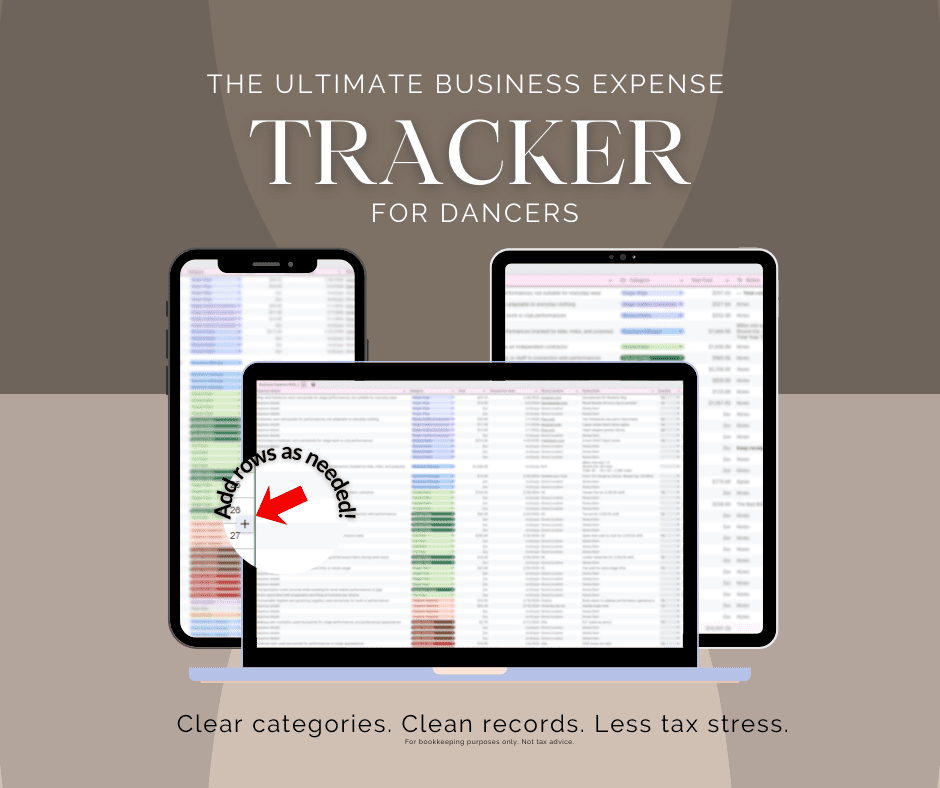
Keeping receipts, mileage logs, income tracking, and expense categories makes tax season less stressful and reduces the risk of surprises.

Final thoughts
Deductions don’t eliminate taxes, but they lower your taxable income, which can significantly reduce what you owe. Even saving a few thousand dollars at tax time can mean working less out of desperation and more from a place of choice.
You don’t need to be perfect. You just need to be intentional.





Leave a Reply