
Table of Contents
No one tells you how confusing taxes get when dancing stops being a side hustle and becomes your only source of income.
When I started dancing full time, I knew taxes would be “a thing,” but I didn’t realize how many moving parts there were. Deductions, tip tracking, saving for what I owed, and learning about quarterly payments all hit me at once. This post is not meant to scare you. It’s meant to share what I’ve learned so far and hopefully make your own tax journey feel less overwhelming.
Common Tax Deductions for Strippers
My first year filing taxes with dancing as my full-time income opened my eyes to just how many work-related expenses can potentially be deducted. This is not an exhaustive list, and deductions depend on how you work and how you document things, but these are the most common stripper tax deductions I learned about.
Performance and Appearance Expenses
The heels we wear in the club and solely for the club can be deducted.
Any costumes or uniforms purchased specifically for the club that are not suitable for everyday wear can be deducted. That microkini set you bought just for work counts.
Wigs and hairpieces can be deducted as long as they are used only for performances and not worn in daily life.
Makeup used strictly for the club can be deducted, including strip lashes and performance makeup.
Press-on nails can be deducted if they are worn for work appearances.
Props purchased for stage or performance use only can be deducted.
Training and Skill Development
Pole classes and dance classes related to improving your performance skills can be deducted since they directly relate to your work.
If you have an at-home pole used for training that can be deducted as well. Some dancers may also deduct a portion of rent for a space used exclusively for work. This is something to discuss with a tax professional, as it can be higher risk if not done correctly.
Courses, e-books, or classes taken to improve sales, stage presence, or performance skills can also count as work-related education.
Club-Related Fees and Tip-Outs
Any house fees, stage fees, room fees, or VIP cuts paid to the club can be deducted.
Tip-outs paid to staff can also be deducted. It is important to track these nightly. If you are unsure how much you paid over the year, some clubs can provide a summary upon request.
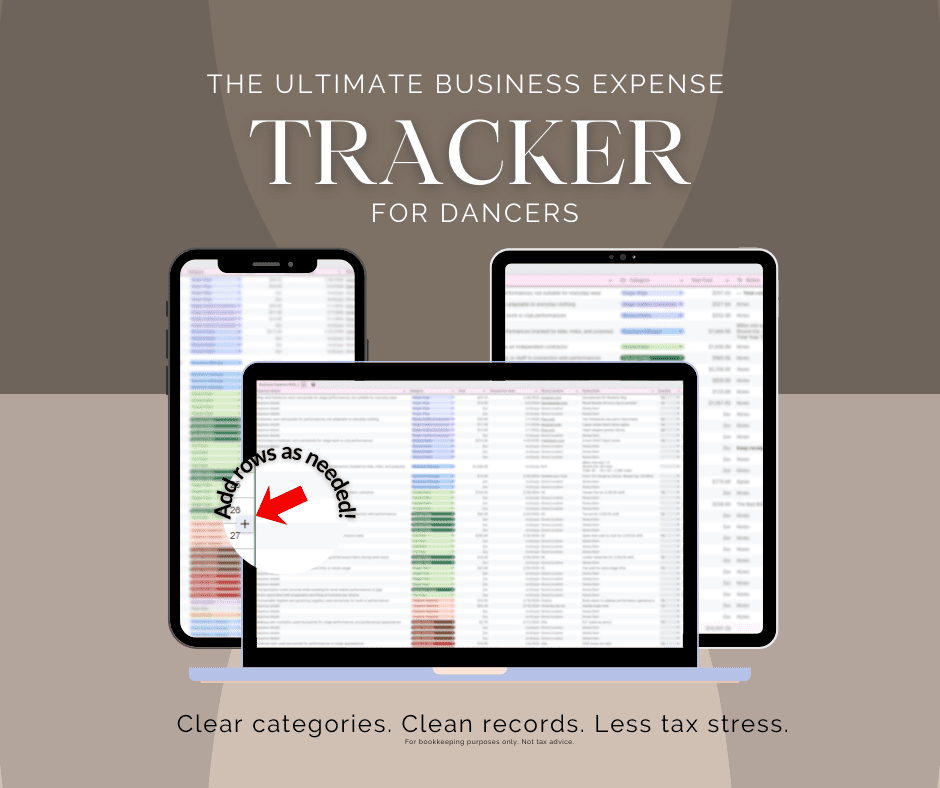
Keeping a nightly tracker of earnings and expenses makes this significantly easier and prevents last-minute scrambling during tax season.

Transportation and Travel
Mileage driven to and from work can be deducted if tracked properly.
Uber and Lyft rides related to work can be deducted.
If you travel for dancing, you may be able to deduct travel expenses such as flights, hotels, car rentals, and meals while traveling for work.
Marketing and Branding
Hiring a photographer for branding or promotional content can be deducted.
Expenses related to promoting yourself as a dancer may also qualify.
Phone, Apps, and Subscriptions
A portion of your phone bill can be deducted if you use your personal phone for coordinating work or promoting yourself.
If you have a second phone used strictly for work, that phone and its bill may be fully deductible.
App subscriptions used for work purposes only may qualify. For example, a Spotify subscription used for creating pole routines.
Supplies and Equipment Maintenance
Hygiene supplies used specifically for work, such as wipes or sanitizer, may be deductible.
Supplies used to maintain work equipment can also count. This includes shoe repairs, glue, sewing kits, or costume repairs.
About Tips and Reporting Income
Tip income is one of the most confusing parts of stripper taxes. Because our income is largely tip-based, keeping accurate records is essential.
Tips earned on stage and tips earned through services should be tracked consistently. Rules around tip reporting can vary depending on your situation, how income is recorded, and how your club operates. This is an area where speaking with a tax professional can be extremely helpful. No tax on tips is everchanging.

Saving for Taxes as a Full-Time Dancer
As much as I like to think I have my finances together, I did not start saving for taxes consistently until late in the year. I was fortunate that I could save what I owed before April, but I would not put myself in that position again.
Now, I set aside money from every weekend I work into a tax bucket in my high-yield savings account. The amount varies. Sometimes it’s a few hundred dollars, sometimes it’s much more. This approach removes panic from tax season and eliminates the need to hustle out of desperation. It also gives grace for those slower nights.
Saving for taxes as a stripper is not fun, but it is far better than being caught off guard.
Learning About Quarterly Tax Payments
Quarterly tax payments are essentially pre-paying your taxes throughout the year instead of paying on large lump sum in April.
These payments are due on April 15, June 15, September 15, an January 15 of the following year. They exist because no taxes are withheld from self-employed income.
To estimate quarterly payments, many people base them on last year’s tax bill or estimate current-year income. Generally, paying at least 90 percent of what you owe for the current year or 100 percent of last year’s tax liability can help avoid penalties.
Quarterly payments can be made online or by check. If you overpay, you may receive a refund when you file your annual return. If you do not pay quarterly when required, penalties and interest may apply.
This is something I am still learning about and will implement more consistently moving forward.
Final Thoughts on Taxes
Taxes as a stripper are not simple (or fair), especially when dancing becomes your full-time income. I am still learning, but being proactive has already reduced stress, burnout, and panic hustling.
Tracking expenses, saving consistently, and educating yourself puts you in control. You do not have to master everything in one year. Progress is enough.
Disclaimer
This post is for educational purposes only and reflects my personal experience as a full-time dancer. I am not a tax professional. Tax laws vary by state and individual circumstances. Always consult a qualified tax professional or CPA regarding your specific tax situation.





Leave a Reply